 Atiu, Cook Islands, is a raised coral atoll with a circumference of about 20 miles and land area of 10.4 square miles. Its 230-foot-high central plateau is surrounded by low swamps, beaches, and a 66-foot high coral reef containing many
underground caves. Fertile volcanic soil and freshwater springs in the
valleys allow cultivation and export of citrus fruits, taro, bananas, copra, and
papayas. Coffee is also grown. Shipping is hampered by the lack of an
adequate lagoon behind the fringing reef but there is an airstrip on the
northeast coast. In the 1980s more than 1200 people lived in the island's five villages (by 2010 there would be only 511).
Atiu, Cook Islands, is a raised coral atoll with a circumference of about 20 miles and land area of 10.4 square miles. Its 230-foot-high central plateau is surrounded by low swamps, beaches, and a 66-foot high coral reef containing many
underground caves. Fertile volcanic soil and freshwater springs in the
valleys allow cultivation and export of citrus fruits, taro, bananas, copra, and
papayas. Coffee is also grown. Shipping is hampered by the lack of an
adequate lagoon behind the fringing reef but there is an airstrip on the
northeast coast. In the 1980s more than 1200 people lived in the island's five villages (by 2010 there would be only 511).
Early in 1988 the corporation I worked for was acquired in a hostile takeover and my department eliminated. My March 50th birthday put me in a "protected" category that increased the size of my severance check, and I found consulting work one week a month for as much income as I'd been making in a full-time job. Suddenly free of traditional work hours and with plenty of money, I could do something I'd been interested in for a long time -- join an Earthwatch expedition.
Though tempted by Tracking Orangutans in Borneo (more about this later), I was most intrigued by an archeology/anthropology expedition to Atiu Island (or Enuamanu, land of the birds) in the Cooks. My friend Nikki joined me. The following and some future posts will cover highlights from the journal I kept during the trip.
 |
| Our room in Rarotonga |
 |
| Dr. Sinoto and Dr. Stephenson |
Our expedition leaders Dr. Rebecca Stephen-son, Dr. Hiro Kurashina, and the senior investigator, Dr. Yosi Sinoto held a press conference this morning describing our goals -- to trace the route of Polynesian colonization through archeological artifacts and to observe changes in island culture by comparing our journals to similar information collected by Becky in her year on the island for her doctoral study a decade ago.
At lunch today we were told the difficulty of Earthwatch trips varies a great deal. One woman, on her eighth expedition, said the Borneo trip was the toughest. At times they tracked the orangutans through waist-deep swamp water and afterwards had to pull leeches off each other. Because they moved from place to place, their camp sites and facilities were temporary. At one site, the team leaders were concerned about a wild boar in the area. So their night visits to the latrine -- a wooden plank over a large hole -- required balancing on the plank while holding a flashlight and a club.
 |
| Nikki left front, Mary middle front |
In contrast, we look forward to a welcome from friendly and loving Māori islanders. Two members of our group have been to Atiu with Earthwatch before. Both are back because they became so attached to their hosts. Each of us will live with a family for two weeks, and those two will stay with the same families as before.
At today's briefing we learned that Māori is a directive language. Technically, "please" and "thank you" do not exist, so we shouldn't be surprised if told "Do this!" Reciprocity is integral to this culture. If you admire something, an Atiuan will feel obligated to give it to you. The same goes for us -- we'll know what gifts to give members of our families by what they admire among our possessions. The Māori have a saying that things "get legs." The children will be curious about jewelry, or small alarm clocks, or watches. If we leave such things lying around, they might disappear.
 |
| Umukai (feast) |
There will be a conspicuous display of food, and we'll show our pleasure by eating a lot, though not necessarily everything. We asked a man who was here last year what that really means. He said, "It means six meals a day."
Thursday, July 7, 1988
Nikki and I awoke early in Rarotonga yesterday from anxious dreams about being in unfamiliar territory. After two weeks on the island of Atiu we'll probably come back to the "civilized" world and wonder why we do all the things we do. But in these early days we'll have to adapt to a simpler life. Few Atiuan homes have running water, for example. Instead, most collect rain water. Becky says "When it's time to wash up you'll take a pitcher and basin to the bath house. Do it the way birds do."
 |
| Nikki wearing a pareu |
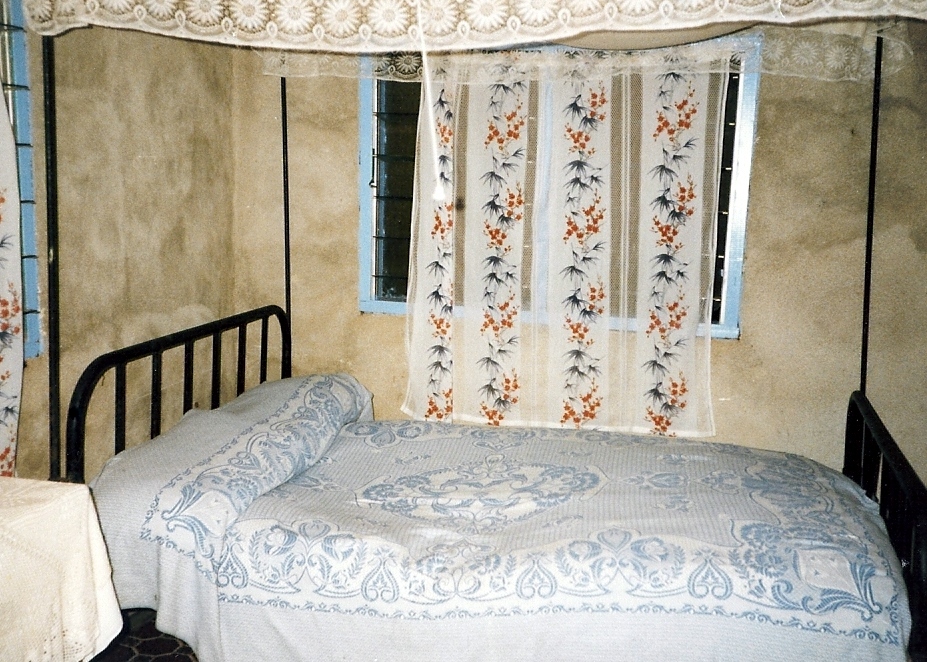 |
| My room in Papa Tu's home |
 |
| Our outhouse in back |
So
much is new, some expected because of our briefings, some surprising.
It's certainly true, as we've been told by many people, that families
here are wonderfully generous and caring. I have the good fortune to
live at the home of the mayor, called Papa Tu by everyone because of his position in the village, and his wife Teu Mere, or Mere for short -- a name pronounced like mine: Mare-Ray, though I'm to call her "Mama."
 |
| Mama (Mere) on the right, in blue |
After the second plane arrived, we were all taken to two umukais (feasts), the first an official greeting by Papa Tu and the head ariki (chieftain). Because it's customary for guests to eat first, our hosts did not join us in this feast of passion fruit juice, chicken, bananas, cookies, marinated squash, and a staple of the island called taro. This bland-tasting root looks somewhat like a sweet potato, although it can be grey or white or pink. Papa Tu says the color varies by where it's grown and how much moisture surrounds it.
 |
| Umukai (feast) |
My island family is highly religious. Yesterday evening, after I was shown to the bath house and we had coffee, tea, and more taro with butter, some of the children and Mama's sister Rongo came in for evening devotion. Papa Tu played the guitar while all sang a folk hymn in a combination of Māori and English. Mama and the children alternated reading verses from the Bible in Māori. In my honor, Papa Tu read in English. Then we had a closing prayer.
Papa Tu and Mere have raised 21 children; only the two youngest boys still at home. Newton is 10 years old and very handsome, named after the town in New Zealand where five of their children lived at one time. Another son lives in the next village because he has a girlfriend there. I asked if they are married, and Papa Tu said, "Not yet. It is better that they know each other first, so they don't divorce right away, as so many have done." This son and his girlfriend have a two-year-old boy.
Papa
Tu is very proud of his family, especially his oldest brother, who has
passed away. In their inside sitting room are photographs on the
walls, decorated with shell necklaces. This brother's picture is
displayed prominently next to one of Papa Tu when he was younger. This
oldest brother, Vainerere Tangatapoto, was Becky Stephenson's "Papa" on
the island -- the one she lived with for a year and a half thirteen
years ago while collecting data for her dissertation in anthropology.
Papa says his brother loved Becky like a daughter and she loved him
like a father.
Clearly, Papa Tu's favorite son is his namesake, who lives in New Zealand and is very much missed. Papa recalls with great tenderness Teio Tu's helpfulness as a boy. Mama says Teio Tu helped Papa put up the kitchen ceiling when he was only 12 years old.
Clearly, Papa Tu's favorite son is his namesake, who lives in New Zealand and is very much missed. Papa recalls with great tenderness Teio Tu's helpfulness as a boy. Mama says Teio Tu helped Papa put up the kitchen ceiling when he was only 12 years old.
There
are other children about, mostly nieces, and one granddaughter. Of one
of the nieces, Tau, Papa Tu says her parents are "not good." These
relatives of Mama's, he said, drink a lot and go away at night with
their "gang," leaving the children unattended.
 |
| Papa Tu with the children |
Mama speaks English quite well, though not as fluently as Papa. This is, I suspect, partly due to personality, and partly to roles. Papa Tu does most of the talking and he's the one who decides what's appropriate behavior for me. Mama is present, adding comments or laughing.
In this morning's briefing we were asked to describe to the Earthwatch group what we've observed so far, and I found myself tongue-tied, trying to share how open my family has been and how touched I am by their stability and spiritual depth. Though many described themselves as happy with their families, I believe I'm the luckiest to be with mine. I'm interested in the island's history and traditions, and my family holds to most of the historical culture.
 |
| Mama dressed me in a traditional costume |
There was much laughter in my family, for example, when Mama dressed me in this traditional costume.
Friday, July 8, 1988
I
slept soundly, in spite of some on our team telling me of cockroaches
and other insects in their rooms. Awakened by bird calls, I remembered
being a child on my grandparent's farm and hearing the cocks crow in the
early morning, though the Mynah birds are certainly a new touch.
 |
| Mama waiting for me to eat |
For
breakfast we had shredded coconut, taro, fried eggs, papaya, cabin
bread (a thick cracker), butter, and mashed bananas fried with arrowroot
(looks like a potato pancake)--delicious. And Mama is generous to
ensure there's always hot water for my herb tea. For lunch we had the
same food as at breakfast, with the addition of both fried and fresh
bananas. I think Papa Tu gave Mama this instruction because I said I
love bananas. Mama says grace in Māori before each meal. Papa Tu repeats
it in English.
I've learned to say Kia Orana
("May you live"), a special greeting that's more than "hello." This
morning, as Papa Tu and I sat outside the house in front, everyone who
passed said "Morning," with an Australian-sounding accent. I learned
this was not for my benefit, but rather a typical greeting. All the Atiu tupu talk and joke in Māori in
my presence. I feel happy rather than excluded, knowing they act
naturally around me, even though I'm sure they're sometimes talking
about me.
 |
| With Jay at today's dig |
One
team member, Jay Powell, is staying at the home of Mama's sister, who
sent him over here for lunch because she didn't know we'd take a mid-day
break and hadn't prepared food. Papa was charming and funny, trying to
get Jay to eat more. I said I'd already proven I "eat like a pig." This
is a family joke because the Māori word for papaya, vipuaka, literally means "food for the pigs." Before the Europeans arrived, the Māori never ate papaya; they only fed it to the pigs.
 |
| I'm sitting near the cab, white socks and sneakers |
On
the way home from the dig today, our truck driver stopped at the harbor
to let off a young German woman and English man who had wandered the
island while their ship unloaded its cargo. On the deck we saw crates
and crates of beer marked Atiu Motel. Papa has told me of
attempts to reduce the amount of drinking in the village, especially
among the young people. He discussed this with all the parents, who
agreed to enforce a curfew. Many wanted to completely ban drinking, but
Papa understood this would simply lead to rebellion, and too many young
people were already leaving the island.
 |
| Papa Tu |
 |
| Spirit House (Marae) |
 |
| Earthwatch Team and families in front of C.I.C.C. I'm back row, second from right |
Papa Tu told me today the traditional hymn we heard on our arrival is from Psalm 25:
Those who trust in the Lord are like Mount Zion, which cannot be shaken, but endures forever. As the mountains surround Jerusalem, so the Lord surrounds his people both now and forever more. The sceptre of the wicked will not remain over the land allotted to the righteous, for then the righteous might use their hands to do evil.
 |
| Some of the children surrounding me |
Tonight at evening devotion Papa Tu's family and I sang this song in English, accompanied by Papa Tu on guitar: He is able, He is able, He is able to carry me through, heal the brokenhearted, set the captive free, make the lame to walk again, make the blind to see.

This
led to a story from Papa about a visit to New Zealand, when his older
brother taught him how to use a fork. In one restaurant Papa embarrassed
his brother by asking a member of the staff if he could eat with his
hands. The answer was "Yes." Then lobster was brought in, and Papa felt a
step ahead of everyone.
 |
| Islanders & Earthwatch team; I'm in red shirt, middle |
Saturday, July 9:
We had our first work day yesterday, but not a long one, only about
five hours. We can walk to this site and cleared off about one-third of
the Marae at Vairokaia, on land next to my family's
plantation. Among the whole team we excavated pig's teeth, a flake, and
what appears to be the top of a fireplace, as well as many shells. The
boys from the village, who helped us clear away the site, climbed up
nearby trees and brought us fresh coconuts to have with our lunch. After
drinking the coconut milk, we were shown how to scrape the fresh
coconut out with our thumb nails.
 |
| Musicians at singing competition |
In
the evening there was a singing competition and dance. Two of the four
finalists, as well as the guest singer, are from Papa Tu's extended
family. It is the custom here to take small coins (10 or 20 cents NZ)
and throw them in a basin in front of the entertainer. Some people show
their pleasure in the music by dancing on their way up to throw a coin.
With only a little coaxing from Mama, I danced my way up with a coin.
 |
| Tangiia |
Today, I learned from Papa Tu the meaning of some names. Our village is Tengatangi after a chief of the old days--Tangiia--who was very popular in the Cook Islands. The village's original name was Taturoa ("standing point that is long"). A village farther toward the coast is Ngatiarua.
Papa Tu's given name is Teiotu-O-Tangaroa ("The Standing Mirror of Tangaroa). Tangaroa was the god of gods, and the "standing mirror" refers to a clear lake where Tangaroa was said to have looked to see if all the other gods were happy.
 |
| Mama and Papa Tu in front area of house |
Mama's name, Teu Mere,
is her wedding name, not the one she was given as a child. Her older
sister was Papa Tu's first wife, who died in her early thirties. Papa Tu
considered moving to New Zealand at that time, but the families got
together and decided he should marry his wife's younger sister, who was
then 18 years old. The name Teu Mere means "something surprising," referring to her sister's sudden death. Their twin sons are named Rouru Ina Ina ("gray hair," after Papa Tu's mother-in-law) and Tangiia (after the famous chief).
This
morning, after being notified that our trip to the caves was postponed
due to rain, some of us walked to the Atiu Motel. There are three units,
with a fourth being built. The owner was away, but we met a couple from
Canada staying there who showed us inside their unit. It's an A=frame
with indoor plumbing, a double and a single bed, and a loft that could
sleep two more people. Food is supplied in the small kitchen area, and
guests are charged only for the food or beverages they use. Papa Tu says
the motel owner, Roger, met his Atiuan wife in New Zealand and came
here "to get away from the rat race." The islanders are not happy with
him, some even urging that he be deported. He built a saw mill to
produce the lumber for his motel, which is made almost totally from
materials found on the island. But he charges dear prices in the mill.
Also, while shops in the village are open only in early morning and late
afternoon, he keeps his shop open for long hours, and the Atiu tupu
believe he is trying to steal their money. Finally, he doesn't impress
on guests the ways of the people here. Papa stopped one woman riding by
on a motor bike wearing short shorts, telling her angrily to go back to
the motel and put on some clothes.
 |
| I'm ready to walk to the dig site |
The
women and female children in Papa's family never wear pants. I wore
Bermuda shorts once, but could see from how he looked away that he was
uncomfortable, so I only wear long pants or a skirt at home. The women
here sit with their ankles crossed, and rarely cross their legs. Yet
I've noticed children bathing together outside next to the house. I
asked Papa at what age the boys and girls are separated to bathe, and he
would only say, "When they are older."
Papa
treats "Mommy," as he calls her, gently, and shares decisions and some
tasks with her, though roles are traditionally delineated. She cooks,
cleans, washes clothes. As head of the household, he governs through
participation much the way he governs as mayor. Mama rarely tells me
what to do as he does, but apparently influences his decisions. For
example, I had told her I couldn't eat all the food she sent with me for
lunch, and when Papa was late for dinner she confided in me that she
had told him not to insist on so much food for me. When he is away, she
and I laugh as if we were sisters, and even plan jokes to play on him,
as we did with my noisy slurping of food. They both laughed heartily
with me.
Papa Tu's home office is in the front bedroom across from mine. He
says Mama insisted on having a bed where he could sleep when he works
late.

 The
children seem to live next door in the second house, where Mama's
sister also lives, and only come here for devotional services. When they
do peek around corners Papa admonishes them to be quiet.
The
children seem to live next door in the second house, where Mama's
sister also lives, and only come here for devotional services. When they
do peek around corners Papa admonishes them to be quiet.He told me they are "too noisy" to live in this house, but I think some of them sleep here when there are no guests.
Sunday, July 10,1988:
Wero ("to cast a spear") is a traditional Māori challenge at a pōhiri, or welcoming ceremony, to ensure that visitors come in peace. It also establishes their steadfastness, and the prowess of the challenging warriors.
 The male members of Nikki's family took her to a tu munu
(brewery) last night, where only women visiting the island
are allowed (for local women it would be considered a disgrace). tu munu sites are in the middle of the jungle, the
beer brewed and stored in the hollowed-out trunk of a coconut tree. The
brew itself is fermented orange, and generally takes about a week to be
ready to drink. Nikki said the beer tasted like fruit punch and she didn't drink much, worried it would be too easy to
get drunk. A recording she made sounded like a noisy bar
anywhere. Singing, music, laughter.
The male members of Nikki's family took her to a tu munu
(brewery) last night, where only women visiting the island
are allowed (for local women it would be considered a disgrace). tu munu sites are in the middle of the jungle, the
beer brewed and stored in the hollowed-out trunk of a coconut tree. The
brew itself is fermented orange, and generally takes about a week to be
ready to drink. Nikki said the beer tasted like fruit punch and she didn't drink much, worried it would be too easy to
get drunk. A recording she made sounded like a noisy bar
anywhere. Singing, music, laughter.Meanwhile Jay and I accompanied my family to their Saturday evening prayer meeting, where everyone in the group was asked to share something. When it was my turn, I spoke of my pleasure to come half-way around the world and hear children singing songs I had learned as a child: "Rock my soul in the bosom of Abraham" and "What a friend we have in Jesus." I could barely keep my composure when members of the group sang a welcome song, then filed by, kissing each of us one by one and saying "I love you, in the name of Jesus." Papa Tu also read Psalm 133 in Māori: "How good and pleasant it is when brothers live together in unity. . ."
Mama
has a very clear singing voice, and helped guide me through the hymns
in church today. I was also able to follow the hymnal pretty well. She
told me later that people watched my lips and were happy to know I was
singing in Māori.

After
church there was a meeting for women only. This involved a combination
of individual responses to today's bible text and spontaneous dancing,
usually started by an older woman. Mama says they call this woman, Mama Mika, their "comic." I was invited to dance, and tried to imitate the hula-like movements, which generated much laughter.

Though some Earthwatch members modeled traditional island dresses made for them by their Mamas, most of the local women wore modern dress to church. All them have brimmed hats, and Mama loaned me a white one with white ribbon trim. She had hand-woven this hat, heavy enough to withstand today's strong winds. When I commented on the winds' force, Mama said her parents were in a hurricane before she was born that was so terrible all the houses and trees were flattened. People survived only by running into the valley below.
 |
| Maru |
Returning
from a walk after church, I met a young woman from New Zealand as she
was leaving our house. She's here to study local music in preparation
for a Master's degree in music, and was seeking Papa Tu's permission to
tape record his family's traditional challenge to
distinguished visitors. Though she'd tried to convince him it might
otherwise be lost to posterity, he would not give permission. I asked
Papa about this, and he said it is a welcome greeting allowed only to
his family. I've seen him willingly agree to other requests, so I know
this is a real family secret.
This afternoon after lunch, our Earthwatch senior investigator Yosi Sinoto came by to find out who in Atiu is most skilled at making tapa cloth from ava bark, and Papa pointed to Mama. She showed us a photograph where she is pounding the cloth over a log. Yosi said Hawaiian Air
will pay her airfare and hotel for a week in Honolulu, plus $75 a day.
In return, she will present at a two-day workshop demonstrating and answering questions about this
traditional method.
Papa, trained by his father in the traditional ways, answered many of Yosi's questions and is negotiating to accompany Mama. He showed us a hand-knotted fishnet used to catch flying fish in the old way. Papa is now the only one on Atiu who can make an akeikei (fish-catching basket) in the traditional manner because none of the young ones want to learn how. He also spoke of picking anani (oranges) as a boy and rowing a thousand cases at a time out to the ship, because the reef is too dangerous for ships to dock at the wharf. Mama said the pickers would climb the first orange tree, then leap from tree to tree by the branches.
 |
| Mama making tapa cloth. |
Papa, trained by his father in the traditional ways, answered many of Yosi's questions and is negotiating to accompany Mama. He showed us a hand-knotted fishnet used to catch flying fish in the old way. Papa is now the only one on Atiu who can make an akeikei (fish-catching basket) in the traditional manner because none of the young ones want to learn how. He also spoke of picking anani (oranges) as a boy and rowing a thousand cases at a time out to the ship, because the reef is too dangerous for ships to dock at the wharf. Mama said the pickers would climb the first orange tree, then leap from tree to tree by the branches.
Monday, July 11, 1988
Because it's not economical to grow ara (pineapple), Atiu is losing potential trade in taro, nu (sprouting coconut), and akari (mature coconut) that used to be shipped ot New Zealand along with pineapple. Ships will not come unless there is a minimum of 300,000 cartons of pineapple. Coffee production is also slacking because there's been difficulty collecting payment for the coffee beans already shipped. Vanilla beans are now being planted for export, but they won't mature for a couple of years. The freight costs prohibit exporting spices.

While Papa and I were discussing exports, Hiro stopped by with a young man who has a brown belt in karate. I had told HIro about my brown belt, and they were here to invite me to their karate class on Wednesday evening. I told him I cannot practice because of my neck injury, but will be delighted to observe. Two of Para Tu's sons (the twins) have black belts.
Today, there was much talk about the three nieces and two granddaughters who will return tomorrow from Rarotonga, where they have been attending a conference for the Girls' Brigade.We looked through family photo albums, with pictures of granddaughters Mata Tu and Rima, and nieces Vaine (wah-ee-nay), Ina, and Aketaau. The albums highlighted the 21st birthday of the twins because 1st and 21st birthdays are special events on Atiu (other birthdays are noted, but no gifts).


No comments:
Post a Comment